
Introduction: What is the BRPG?
The Bible Role-Playing Game (BRPG) is a tool for exploring the Old Testament. Its mission is founded upon 2 Timothy 3:16-17, which says: “All Scripture is given by inspiration of God, and is profitable for doctrine, for reproof, for correction, for instruction in righteousness, that the man of God may be complete, thoroughly equipped for every good work” (New King James Version). The BRPG acts as a tool for exploring biblical stories, themes, and context through study and role-play.
The BRPG is a table-top role-playing game. Table-top means this game is physical (as opposed to digital). Role-playing refers to how the participants (or “players”) engage with the Old Testament context, which is through playing the “role” of a person from the Old Testament setting. The BRPG is called a game because it uses “quests” or “adventures” to explore the Old Testament context, culture, and biblical story through a coherent and holistic story.
The game has multiple “players” and one “host.” The host is the one who has studied the Old Testament world, created quests, and runs the game world. This means the host reacts to the actions of the players from the perspective of the story or setting they are in. For example, the host may describe a new setting the players have just journeyed to or become the voice of a non-player character they encounter. The host is the one who must extensively study the context, biblical setting, and themes present in order to explore them through quests with the players.
The players role-play as characters in the Old Testament setting of their quest or adventure. They must work together to complete their quest (for example, delivering an urgent message to another city). While the host describes the setting and quest, and attempts to immerse the players into the biblical world, the players can explore the world as creatively or straightforward as they wish (for example, they may hire someone to deliver the message, attempt to shoot the message tied to an arrow from a mountain, or simply travel to the city).
Getting Started and the Method for Interpreting Scripture
To get started, the host must choose a section of Scripture to explore. In order to explore this section of Scripture, the host must remember that the biblical story only includes details relevant to the theological message. There are plenty of other things going on at the time of this story, so the host can take creative liberty crafting quests around this time. The details of the story that are theologically relevant should be communicated as such. Additionally, all contemporary biblical stories should be collected (based on a chronological chart) and reviewed.
Example
As an example, 2 Kings 15 will be the focus passage. In 2 Kings 15 Azariah becomes king of Judah. He is described as a good king, but for some reason the Lord struck him with a disease until he died (2 Kings 15:3-5). This is not much to work with. However, examining the chronological chart in Appendix A will show that there are a number of other events happening at the same time. First, 2 Chronicles 26 describes the life of Azariah (called Uzziah) in much greater detail, especially his sin against God which lead to his leprosy. Additionally, one can see Isaiah 1-6 happening around the time of Azariah’s reign (Uzziah also mentioned in Isaiah 1:1). In the northern kingdom of Israel, Jeroboam II is reigning (2 Kings 14). Additionally, in the North the prophets Amos and Hosea preach repentance toward the people (Amos 1:1, Hosea 1:1). The reigns of Azariah (Uzziah) and Jereboam II as well as the prophetic ministries of Isaiah, Amos, and Hosea all overlap in this period, giving plenty of material to creatively retell and walk players through.
Suggested Theological Resources
In order to communicate theological and biblical truth in the context of the Old Testament, the host must study the story’s background. This should be done through a chronological chart, maps, background context commentaries, culture commentaries, and theological commentaries.
Chronological Chart
A chronological chart is very straightforward. The host must understand what is happening at the same time in order to overlap the historical events. Players can explore different theological themes through the different events happening at the same time. Additionally, understanding as much as possible in the biblical timeline will help to guess the general feeling of Israel at the time (for example, if prophets are all throughout Israel at this time then players should expect a high level of unrepentant for sin from the general population). For more detail on a Bible chronology, see Appendix A: Chronology.
Maps
A map is an indispensable tool for retelling and exploring the biblical story. The recommended method is to hand-draw a large map with tribal/national borders and landmarks (large mountains, the Jordan, the ocean, the Dead Sea, etc.). Detail should center around the geographical location of the story. If the story is in East Manasseh, the map should have a handful of notable cities, landmarks, elevation changes, rivers, and terrain. These details will help tremendously with narrating the surroundings of the players as they travel through Israel. For an example of a map, see Appendix B: Maps.
Theological Context
A solid biblical commentary is helpful for understanding what theological themes should come to the surface through the historical event. For example, one theme present in 2 Chronicles 26 (the Lord inflicts the good king Uzziah with leprosy) is that even those remembered as righteous can greatly fall to pride. A theological commentary can aid in quickly understanding what is present in the specific story. Additionally, a Bible handbook can quickly aid the host in understanding the whole theological context of the book of the Bible or narrative movement around the specific story. Using a theological commentary and Bible handbook to look at all relevant sections will greatly reduce the time needed to set up for the host.
Example
The focus passages will be briefly explored with theological context. The Bible Knowledge Commentary notes, “Uzziah’s great power led to pride, which proved to be his downfall.” Clearly, pride is part of this theological theme. An Introduction to the Old Testament Historical Books makes a point to describe how Chronicles is a retelling of Judah’s kingdom with specific focus on proper spiritual worship. Proper worship is on the mind of God and the author when looking at the sin of Uzziah. Isaiah, likewise, is focused on how the people need to be reconciled to God through a certain redemptive work. Amos calls the people to moral righteousness (as opposed to inward spiritual revival only), and Hosea offers a clear picture of how God views the sins of Israel at this time (as an adulterous prostitute of a wife). These themes help to set the theological context and message of the story of (divided) Israel at this time.
Background Context Commentary
A background context commentary is helpful for understanding extrabiblical surrounding context. A background context commentary such as The IVP Background Commentary: Old Testament is especially useful when trying to read the biblical text from the perspective of its original audience. A background commentary may also help reveal extrabiblical details from history helpful to retelling the story.
Example
Looking at the focus passages, The IVP Background Commentary: Old Testament notes that Uzziah reigned in a time when Assyria was especially weak, allowing for the expansion of both Judah and Israel. Additionally, the “machines” Uzziah built could have been a certain kind of upper-wall city defense. Additionally, this same source notes the significance of the earthquake which occurred during Uzziah’s reign. According to this source, Amos likely took place over a very short amount of time, rather than decades. There is also an interesting note regarding Hosea, which describes how local villagers would likely mix Yahweh and Baal worship in order to have the best chance of crop fertility, even though prophetic voices aimed to pull them away from Baal and push them toward God.
Culture Commentary
A culture commentary specifically covers details of Israelite culture not necessarily related to a particular biblical story, but rather to a large time period. These will go into detail about what it was like to live in Israel during that time. This is especially helpful to fill in many of the day-to-day details for quests. This includes interacting with realistic, non-player characters and making realistic encounters for the participants. For example, it would be unrealistic for the participants to meet a character during the quest who has a cell phone. In fact, that character might not even be able to read or write! Additionally, a realistic encounter for the participants could be a thief on a mountain pass. An unrealistic encounter for the participants would be a watermelon patch (however, figs may be a sweet alternative!). Culture commentaries are indispensable for creatively retelling biblical stories accurately.
Additional Research and Creativity
Retelling a biblical story requires adding many details not present in the biblical text. Where these details have theological significance, it is important to be aware of the themes communicated through the books, as previously discussed. Where details do not have theological significance, the host can be creative with their storytelling!
Example
For example, when exploring a biblical story the participants might encounter a dozen different characters not present in the original story. The female characters might be stay-at-home mothers or workers (potentially theologically significant). If the story is in Judges, the characters might mix the worship of God with the worship of Baal and see nothing wrong with it (theologically significant). Additionally, the characters may have a variety of black, brown, and dirty blonde hair (not theologically significant). The Bible Role-Playing Game will require the host to add many details not present in the original biblical story.
Other Suggested Materials
Once the story has been developed and understood, it is time to choose the physical objects needed to explore and communicate that story! There are many materials and crafts that can be used to add creative depth to the game.
Physical Space Indicators
One of these helpful tools is Physical space indicators. Physical space indicators are especially helpful for navigating a story with the Bible Role-Playing Game. They essentially consist of a “board,” “surroundings,” and “players.” These indicators are useful for a number of needs, including visualizing the surroundings which allows for more natural creative exploration of the surroundings. Examples of boards include model train settings, construction paper, whiteboard sheets, or hand-made mini-sets. Examples of surroundings include rocks, hand-made mountains, bushes, trees, rivers, animals, and towns. Examples of players include a token (to represent where the players are) or a model train miniature figurine. For a detailed view of some physical space indicators, see Appendix C: Physical Space Indicators.
Character Sheets
Character sheets are pages that store information about the custom-made role-play character for each player. Character sheets come in all kinds of designs, but the most essential attributes of a character sheet include a character’s strengths, weaknesses, personality, combat, and tools. Character sheet information (especially strengths, weaknesses, and combat) is often paired with rolling dice to add calculated randomness to the quest (see Appendix D: Dice and Appendix E: Character Sheets for more information).
As an example, the character sheet for “Denyl” from Appendix E: Character Sheets will be used. Denyl’s strengths include farming, “strength” (see appendix for more details), cooking, and training with a sling. Denyl’s weaknesses include his intelligence and wisdom. Denyl is hard-working and appreciative of animals. Denyl carries a handful of tools and weapons in his backpack. See the appendix for expanded details.
Divider
As seen in Appendix F: Space Divider, a wall can be placed between the host and the players in order to privately plan for the quest. For more information, see Appendix F: Space Divider.
Other Items
The host must be creative with their retelling of the biblical story. This means the host may need to create their own materials, sets, challenges, or tools for their party. This can include printed materials, such as transliterating a Hebrew phrase back into English to find the next clue for the quest. Additionally, small hourglasses can be used to encourage fast decision-making. Music can also add a desired atmosphere. Be creative because the possibilities are endless!
Playing
Creating a Story and Goals
Once a host has chosen a section, studied the theology behind the biblical story, and compiled the materials they want to use, it is time to run the session!
The session will revolve around a central quest or shared goal for the participants. The host can explain the quest outright or give it through a request of a role-played non-player character. For example, the players might start their session in the city of Zaphon (see Appendix B: Maps). They immediately meet a non-player character in the city who gives them context on the current situation in Israel (slavery in eastern Israel for the past few years) and the needs of the people: to over throw the king enslaving them, namely Cushan Rishatiam (see Judges 3). This is one method of giving the goal for the party. The story and goal should revolve around both a biblical story and theological truths found during studying. Additionally, keep a culture commentary close by in case the players ask a technical question the host was not prepared for. Once a main goal is established, the host and players partake in what is called “active creative storytelling.”
Active Creative Storytelling
Active creative storytelling takes place in three stages. First, the host describes the circumstances. Second, the host describes some options the participants can choose. Third, the participants describe their actions. The cycle then repeats. For example:
Host describes the circumstances: “Late at night, the town is largely quiet, though you can hear small chatter and the clanking of soldier armor. This is a military city. The town flickers with torch light in the darkness.”
Host describes options: “No one has noticed you. You can rush in or sneak in. If you want to sneak in, you can try to lure some soldiers out to take their things and disguise yourselves as one of them. Or, you can try to scale the stone wall. Or, you can pretend to be traveling merchants.”
Players describe actions: “We try to scale the wall.” (player rolls dice)
(Repeat the cycle)
Host describes the circumstances: “Your character falls down the wall, unsuccessfully scaling it. You have made too much noise, now some guards have heard you and are heading over!”
Host describes options: “You can flee, fight, or try to sneak in.”
Players describe actions: “We flee!” (player rolls dice)
(Repeat the cycle)
Hosts must be creative with the different aspects of the character sheets. The information about the characters is used in the appropriate circumstances to advance the story. For example, if Denyl (with “+3 strength”) attempts to push a heavy rock out of the way, he will need to roll a 20-sided dice to check his success. If the rock is super heavy, maybe the rock needs a roll of at least “18” to be moved. If the rock is light, maybe even weak players can move it with a roll of at least “8.” If Denyl rolls a “16,” other characters would not have been able to move the rock. However, Denyl adds his character-specific strength of “+3” to the “16,” making “19.” Denyl is able to barely push the rock out of the way. Different strengths and weaknesses can add to or subtract from the chances of succeeding in different circumstances.
Where to Go From Here
This manual holds everything the host needs to begin exploring the Old Testament through the BRPG! The next step is to pick a biblical passage and begin working through the manual with that passage. Make sure to show proper biblical hermaneutics as outlined in “Getting Started and the Method for for Interpreting Scripture.” Once the passage is understood for what it is and for what it is not, the host can move to the next stage, theologically exploring the text, as seen in “Suggested Theological Resources.” When the host understands the theology surrounding the passage, they can acquire any physical materials needed for storytelling and engagement, as overviewed in “Other Suggested Materials.” Finally, the host is ready to play! Make sure to understand “Playing,” especially “Active Creative Storytelling.” Build upon each consecutive session with those players, use creativity, and grow together as students of the Old Testament.
As one final encouragement, remember: “All Scripture is given by inspiration of God, and is profitable for doctrine, for reproof, for correction, for instruction in righteousness, that the man of God may be complete, thoroughly equipped for every good work.” (2 Timothy 3:16-17, NKJV).
Appendix A: Chronology
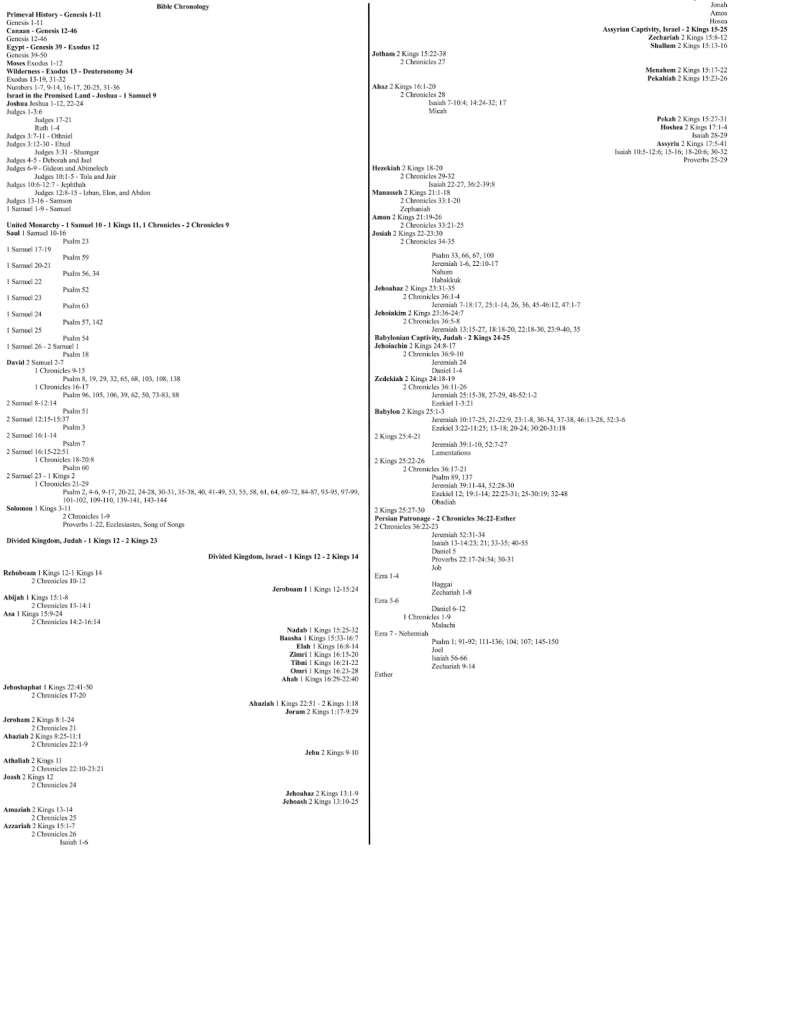
This chronology is placed in two columns due to space restrictions. This chronology of the Bible divides Old Testament history into ten periods: Primeval History, Patriarchs in Canaan, Egypt, Wilderness, The Promised Land, The United Monarchy, The Divided Monarchy, Assyrian Captivity, Babylonian Captivity, and Persian Patronage. During the Divided Kingdom and Assyrian Captivity the events on the left of the column are relating to the southern kingdom of Judah, while events on the right of the column are relating to the northern kingdom of Israel. National rulers of the time are placed in bold.
Appendix B: Maps
East Manasseh
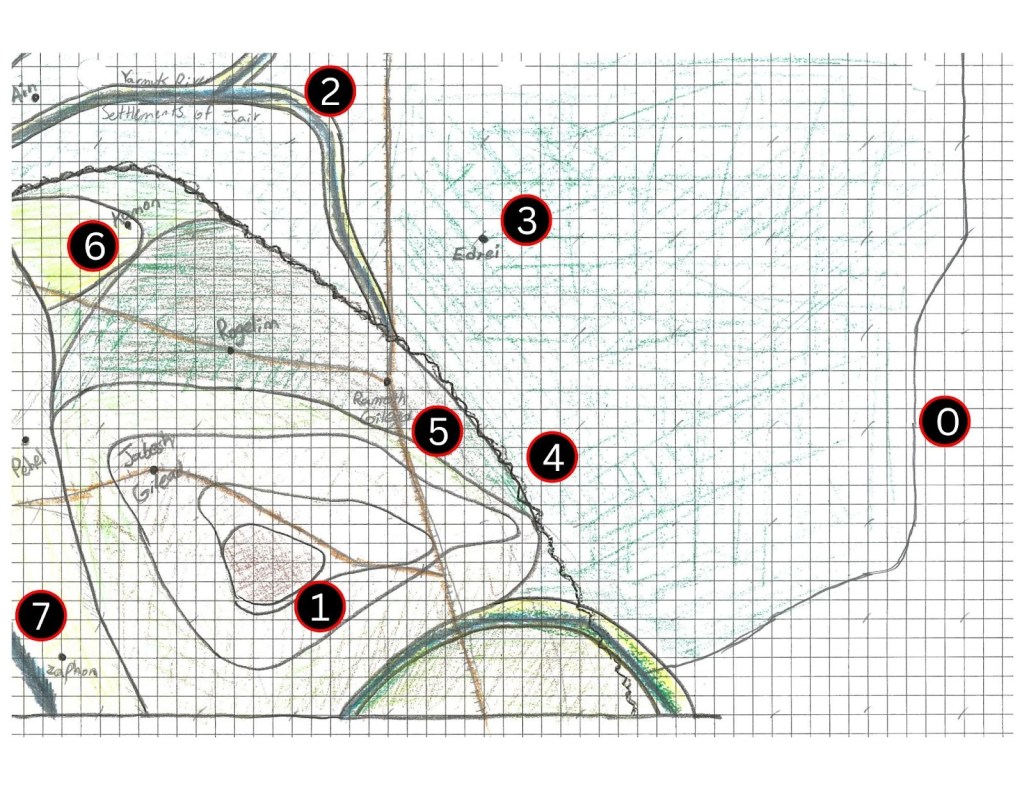
This is a hand-drawn map of East Manasseh. There are eight points of interest on the above map. Each square on this map is around one real-world mile. This section is approximately 50 miles wide and 40 miles across.
0) This pencil line signifies the approximate outer edge of what God gave to the tribe of Manasseh.
1) The different coloration on this document signifies the difference in elevation. This point marks the highest peak of this local mountain, contrasted with the lowest point, (7) at the bank of the Jordan.
2) This blue line signifies a river, with the yellow signifying a lowered bank on surrounding the river. This is the Yarmuk River, with the settlements of Jair on the South Bank.
3) The city of Edrei sits a few miles outside of the Israelite-conquered land.
4) This wavy black line indicates the boundary of Israel’s conquering of Canaan. West of this line is largely Israelite territory, but East of this line is non-Israelite. Between the points (4) and (0) is the land God gave to Israel as their inheritance, but the Israelites did not move into.
5) This point of interest marks the city Ramoth Gilead at the cross between two highways (marked with brown lines), near the tip of the Yarmuk river and the base of the local mountain. This is the last Israelite city if traveling North by the highway.
6) This is the city of Kamon, positioned on a slope between the Jordan River and the rising elevation toward the mountain. The green/yellow gradient indicates an elevation change from yellow (lowest) to green (middle) to brown (highest).
7) This is the city of Zaphon, positioned on the bank of the Jordan River, marked by a jagged blue line.
City
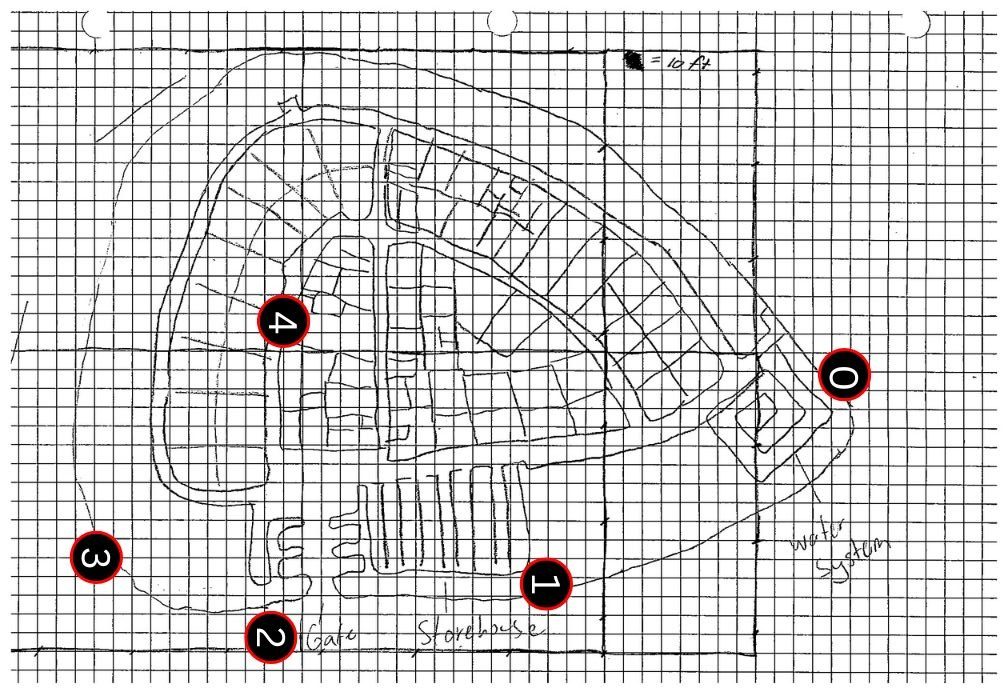
This is a diagram of a city based on Herzog’s “City Plan of Beersheba.” Each square is approximately ten feet by ten feet. The city is approximately 400 feet wide and 300 feet across.
0) This spiral is the water system in the city
1) Storehouse
2) Gate
3) Walls
4) Houses and inner city
Appendix C: Physical Space Indicators
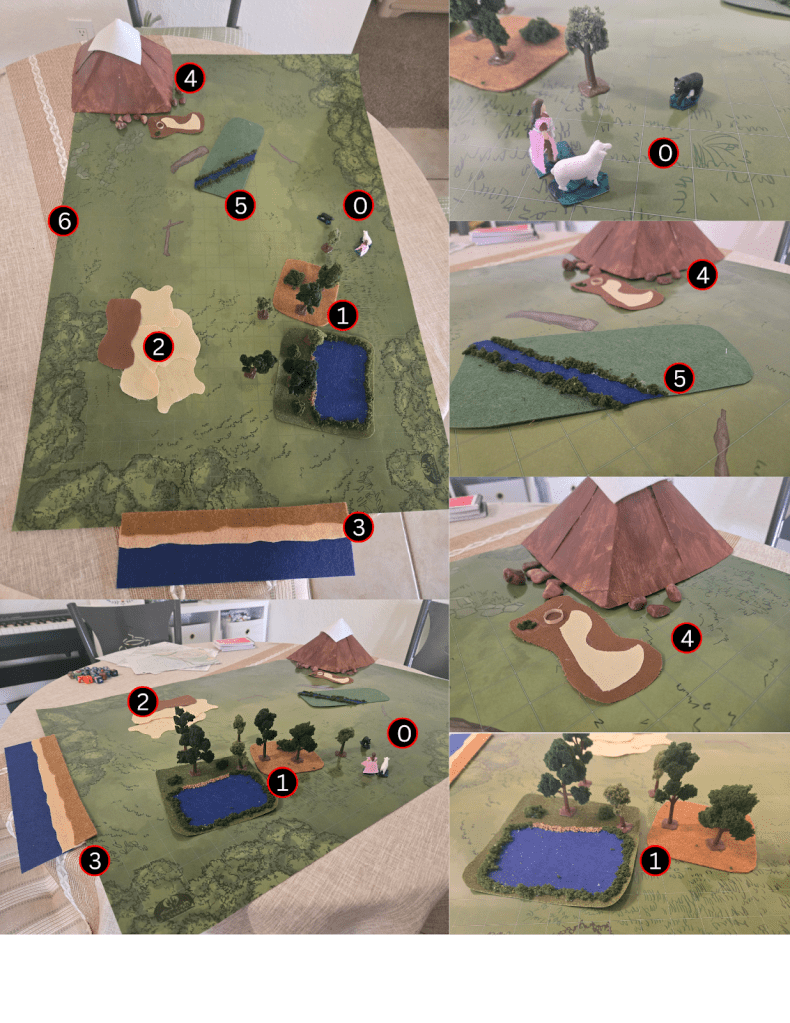
This is a set of physical space indicators used by the author. The physical space indicators help the host and players to visualize the geography for travel, combat, and storytelling.
0) Three miniatures are used to represent the party, their pet sheep, and an approaching bear.
1) The immediate setting of the party is next to a small lake surrounded by trees.
2) In the near distance is an extensive desolate plains.
3) This brown, tan, and blue cloth is used to remind the host and players that they are in western Israel near the ocean.
4) The party is traveling toward a small walled city (surrounded by tan crops) at the base of a snowy mountain.
5) Before the party can reach the city, they must cross a river.
6) This is a dry-erase background paper. The host or party can draw any additional details (for instance, setting up camp for the night) needed. The general terrain in this area is woody. Additional tree pieces can indicate more dense forests, while tan/brown cloth can indicate a break from the generally green terrain.
Appendix D: Dice
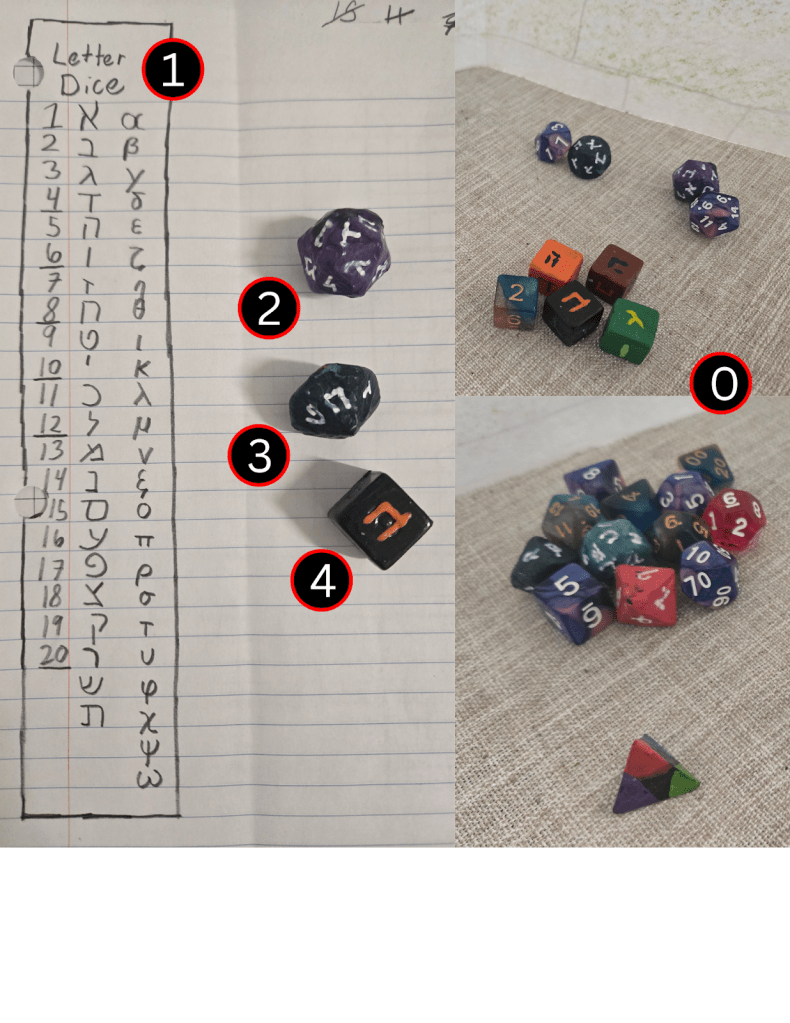
Rolling different kinds of dice adds randomness to an otherwise very structured quest. Additionally, the randomness of rolling dice pairs well with clear strengths and weaknesses present on the character sheets (see Appendix E: Character Sheets).
0) These are some of the dice the author uses. Some have been painted to have their numbers replaced by Hebrew or Greek letters.
1) The dice with Hebrew and Greek letters are equivalent to the numbered dice, but are hard for the players to decipher. The host keeps a page of letter-to-number translation.
2) This dice rolled “Dalet.” According to the sheet, this roll is worth 4.
3) This dice rolled “Het.” According to the sheet, this roll is worth 8.
4) This dice rolled “Bet.” According to the sheet, this roll is worth 2.
Appendix E: Character Sheets
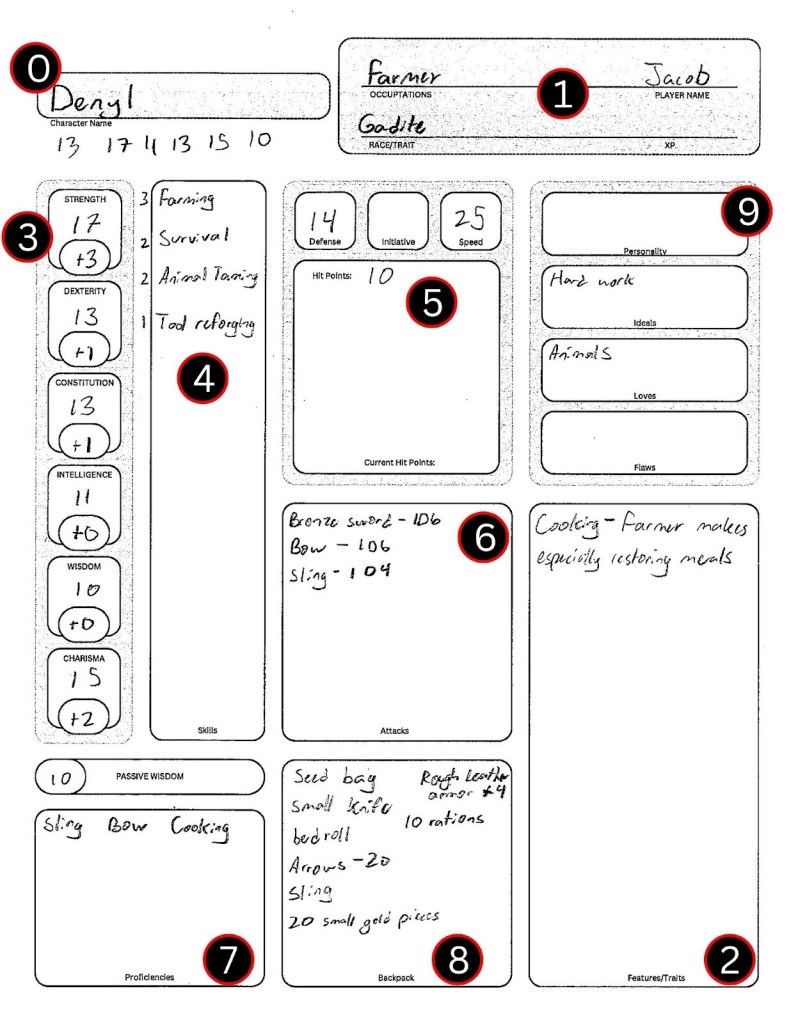
This is a character sheet for the player Jacob who is role-playing as the character Denyl. This character sheet format is heavily inspired by the Dungeons and Dragons Role Playing character sheet. One can use any kind of character sheet, but I have found this layout to work well.
0) The character name is at the top for quick reference (it is easy to forget and need to be reminded)
1) The occupation, race, player name, and experience go here. The occupation is related to what unique abilities the players can use to explore the biblical world. For example, Denyl is a farmer, meaning he may have a better chance dealing with a crazed animal blocking a path than the other party members. Race can come into play, especially for a stealth mission where a lighter-skinned character sneaks into a similarly-lighter-skinned Philistine camp (Philistines were Sea Peoples, who were likely lighter skinned). Experience is collected to eventually “level up” and gain more unique abilities. This paces out the new exploration tools (abilities) and forces players to explore in unique ways.
2) The features/traits section is related to abilities that need explaining. For example, Denyl is an especially good cook, which could be used to make some extra money while traveling.
3) These numbers and “stats” help make the characters all unique with strengths and weaknesses. The “+3” on strength means Denyl is stronger than average. The “+0” on intelligence and wisdom means Denyl is just average. Strength covers brute strength. Dexterity covers precision and accuracy. Constitution covers the ability to push yourself. Intelligence covers knowledge about subjects. Wisdom covers street smarts. Charisma covers the effect on others based on personality. Passive wisdom specifically refers to hidden objects or people. It covers the ability to see something without checking for it. These numbers pair with dice rolls to add structured randomness to the quest. For example, a
4) Skills lists activities the character is especially good at. The number next to the skill is the “modifier.” Denyl is especially good at farming (+3), so if the player wanted to try to recall a fact about farming, the modifier would be Denyl’s intelligence modifier (+0) plus his farming skill modifier (+3) to total (+3) added to their roll.
5) Defense, Initiative, Speed, and Hit Points all relate to combat. Defense is the difficulty number for being hit by an enemy, based on armor. Initiative is a number that changes every time, based on the order of combat in the moment. Speed is how many feet the character can move on their turn. Hit points is how much “health” the person has before dying.
6) This is where the offensive items are placed. Denyl has a little sword, a bow, and a sling, which all can be used for different actions. 1D6 means the player rolls one 6-sided dice to determine the damage on an opponent.
7) Proficiencies are things other characters may not be able to do at all. A person would need to be trained with a sling before effectively using it. Denyl is trained with a sling, so will always know how to use it appropriately. If a different character tried to use it, they would fail.
8) The backpack holds all of the characters unique items. The “Rough Leather Armor +4” means Denyl is wearing a leather tunic acting as a sort of rural protection. It adds +4 defense, but only works naturally. For instance, it would do nothing against drowning or being on fire. However, it may protect him from a dangerous sling of an enemy. An arrow, however, might pass right through.
Appendix F: Space Divider
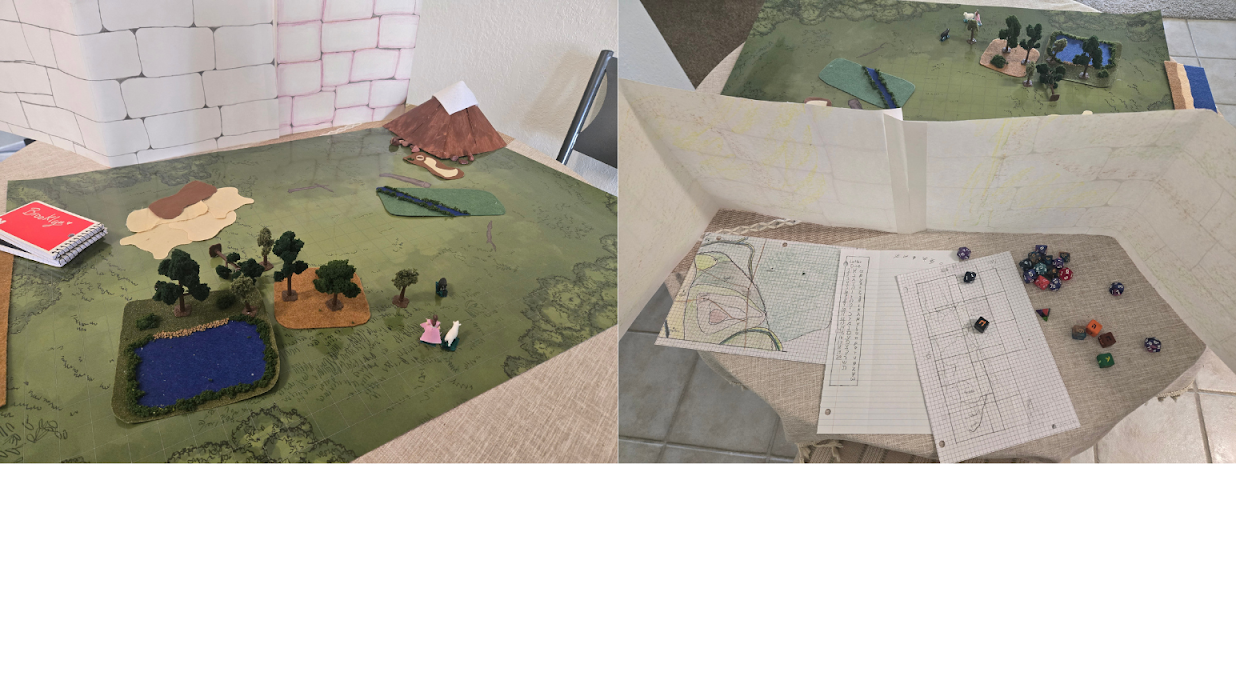
This is the space divider used by the author. The space divider divides the space between the players and the host. The host has a handful of documents hidden from the players, including a detailed map and storyboard (usually on a digital document). This divide allows the host to plan ahead in the journey without letting the players in. The space divider is designed to look like the walls of a walled city.
Bibliography
Bullock, C. Hassel. An Introduction to the Old Testament Prophetic Books. Chicago, IL: Moody Press, 1986.
Cargal, Timothy B. et al. eds. The Chronological Study Bible: New International Version. Nashville, TN: Thomas Nelson, 2014.
Rasmussen, Carl G. Zondervan Essential Atlas of the Bible. Grand Rapids, MI: Zondervan Academic, 2013.
Vos, Howard F. Nelson’s New Illustrated Bible Manners and Customs. Nashville, TN: Thomas Nelson, 1999.
Walvoord, John F. and Roy B. Zuck, eds. The Bible Knowledge Commentary: Old Testament. Wheaton, IL: Victor Books, 1988.
Wizards of the Coast, Character Sheet. p. 1, https://media.wizards.com/2022/dnd/downloads/DnD_5E_CharacterSheet_FormFillable.pdf



 Bible Students
Leave a comment